Week 5
Materiality of Divination, Chicane
The Politics of Divination and Chicanery
To better understand the role of divination in technology, I started my week with a video I found on the Esoteric AI page.
Understanding AI Through the Politics of Divination and Chicanery
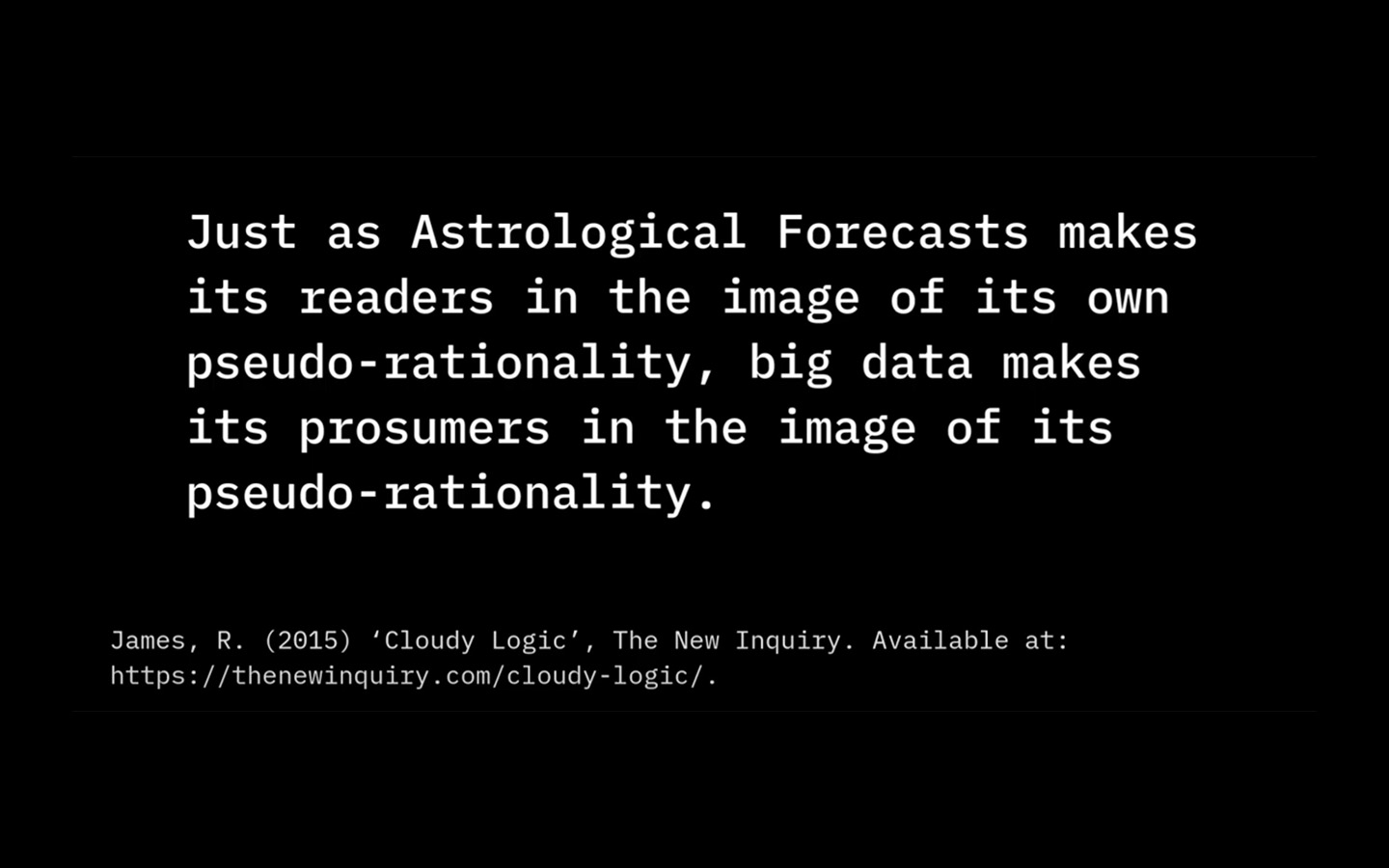
Divination and Big Data
Introducing the Chicane
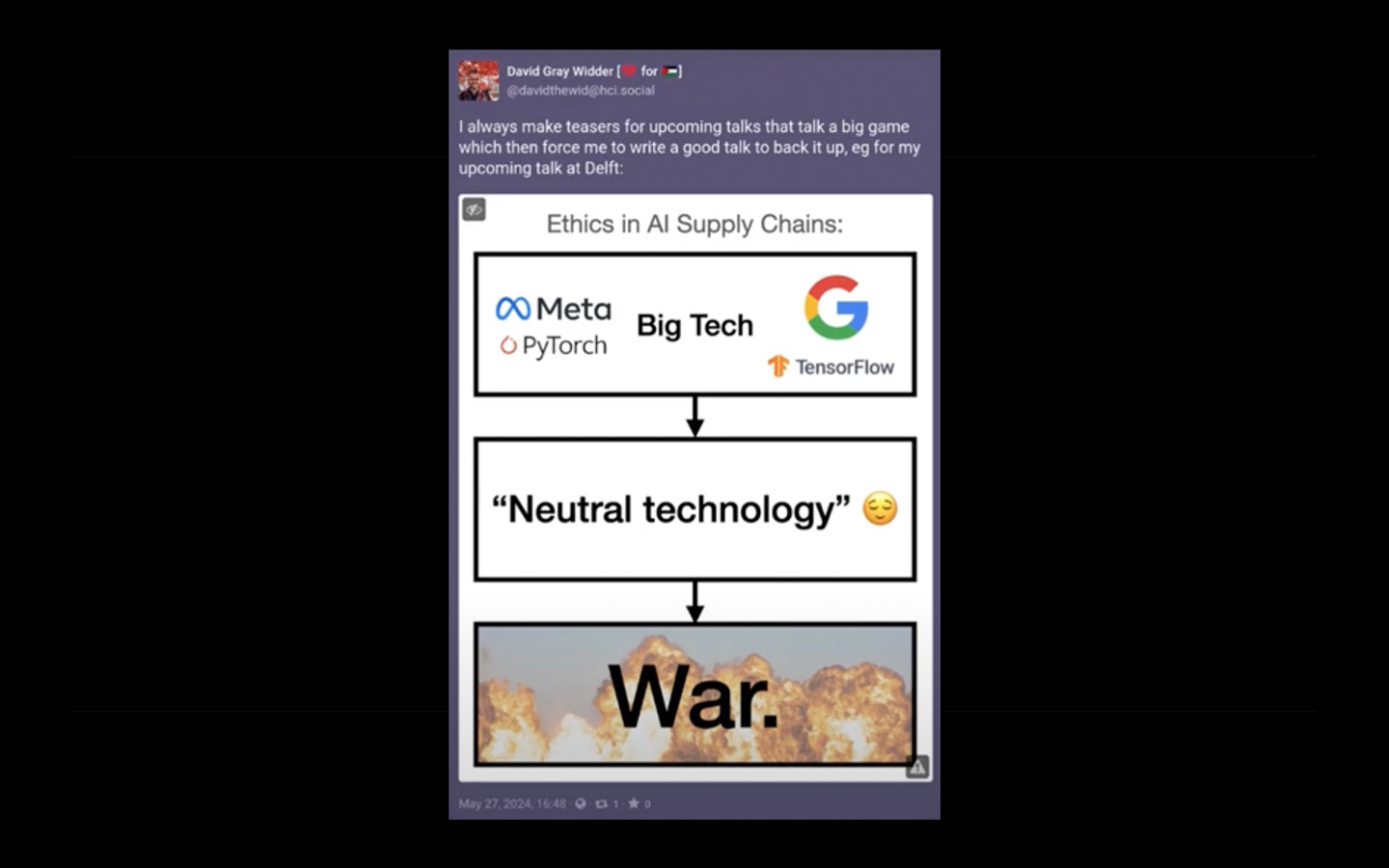
Consequences if we are not aware of manipulation of data/algorithms
In this video, David Benqué explores the topic of non-neutrality in AI and algorithmic systems. He also introduces the concept of the Chicane, which is a mediation of interpretation in divinatory practices (more on this later). As a designer of diagram studies, he then uses the almanac, a publication that presented order and regularity to farmers through the cosmos in the 1700s, as his object for reimagination. He uses modern data science techniques to reintepret the cosmos for market predictions.
Case Study –
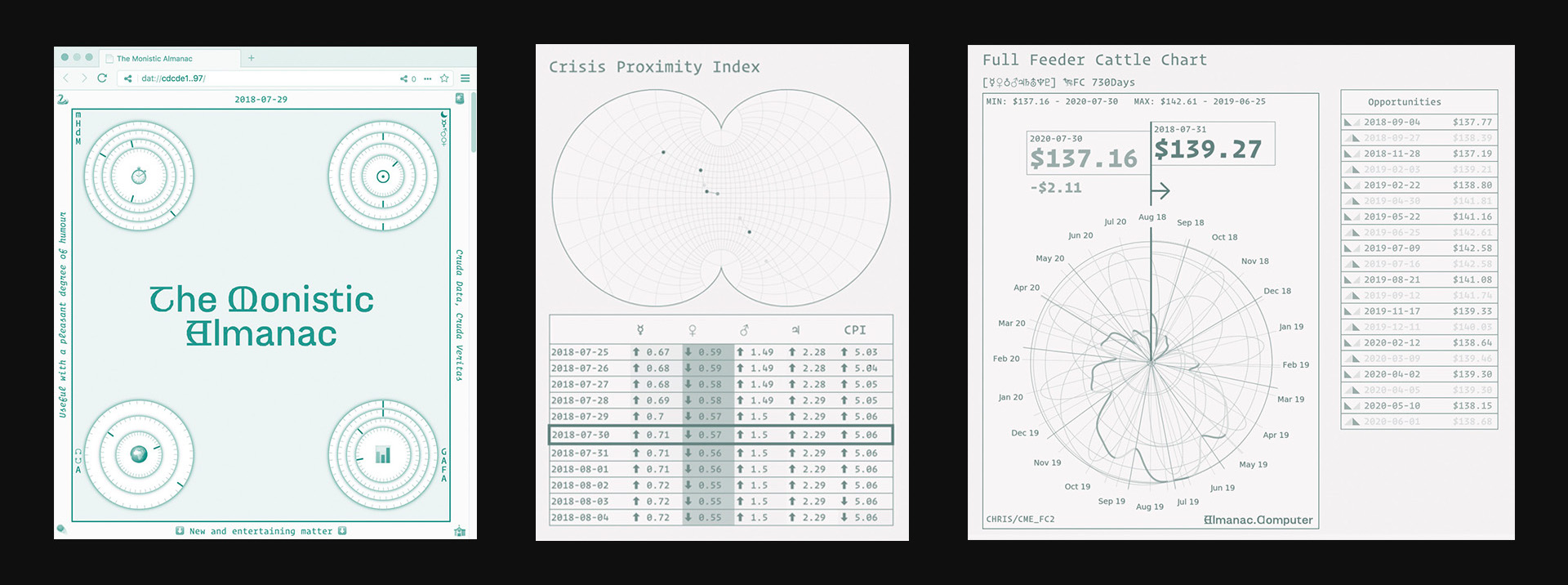
David Benque's Monistic Alamanac
In their various forms, and sometimes within one volume, almanacs are a unique intersection between the scientific, the occult, the mundane, and the miscellaneous. This project revisits this format as a playful site to experiment with data and algorithms, and ultimately question our beliefs in the predictions they produce.
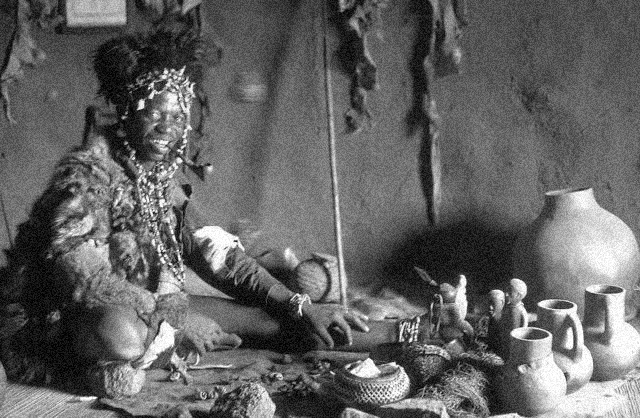
Chicane
Benqué introduces the chicane. A term normally used in road building, it describes a bend in the road that is intentionally built for safety – a diversion.
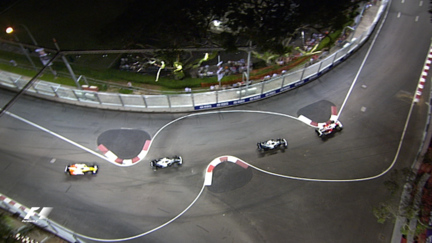
Chicane in racing roads
In the context of divination, Cornelius refers to a diversion created by the diviner to produce a desirable outcome for the client.
The term was put into the context of divination by Geoffrey Cornelius, in which he studied the
process of "manipulation and trickery" in the healing practices of witch-doctors. He made a few
arguments
for the chicane in his essay "Chicane: Double-Thinking and Divination among the
Witch-Doctors".
1. The chicane should not be viewed simply as trickery/manipulation.
2. To perform a chicane requires a complex mediation of signs and symbols of the practise
and
its
client.
3. Oftentimes, practise divination involves double-thinking – a process in which one hold
two
opposing beliefs at the same time.
He suggests that the chicane serves as an invaluable source for hermeneutic studies, relating to
wider categories of symbolic interpretations and double-thinking.
Neoliberalist Markets as Divination
In "Neoliberalism as a political theology of chance", Ramey examines the neoliberalist market
(free-market capitalism) as a disavowed system of divination. He talks about the market as a
system that
aims to turn unpredictable human behaviour into ones that can be analysed and used to predict
trends
– what markets should I invest in? what job career will provide stability and growth? is
now the
right time to buy/sell property? In this system, algorithms are placed as a
'more-than-human'
technology to 'predict' human behaviour, positioning it as the diviner. However, we all know
that the reality of being in this system serves to keep the people in power, in power.
In this case study, the value of examining market behaviour through the lens of divination
allows him to bring a unique perspective towards understanding why we continue to place our
faith in the market system despite malicious behaviour and consequences.
Even if many neoliberals are beginning to lose their nerve in
the face of the climate change catastrophe, political instability, and
social upheaval caused by the continuing failure of the global
market-state, there is a deeply archaic political problem neoliberal
ideology seems to solve, a problem that arguably will not disappear
with neoliberalism. That is the perennial human problem of how to
relate to chance as meaningful. The apparent solution to this
problem, the reduction of chance to mere “noise” in the metainformation
processor of markets, gives neoliberalism part of its
continuing, if ever-more diffuse and obscure appeal.
This, which we can view as an instance of double-thinking as the chicane.
RPO Feedback
Divination in RPO
I reflected all these findings in my RPO and presented it to Andreas on Tuesday. I realised two
things in the consult:
1. I had to find a better way to convey the intersection of technology/divination in my RPO (or
all
my outputs). I realise it is a pretty niche/abstract topic to be talking about, and as Andreas
misinterpreted, it could be simply a project about "chance". It was rather a project about the
human impulse to find meaning from said "chance" encounters in technology.
2. I haven't addressed the design aspect of my research. I got too caught up in the readings
on
divination as a practice that I haven't started looking into how I was going to approach this topic
as
a design project.
Current 3 Pillars
Divination
Data
Design
Actionables
My next steps were to tighten up my writings, figuring out the right balance for how much to write
about
each pillar. At the moment, my 3 pillars are Divination, Data, Design (catchy 3Ds), but I
wasn't sure if Data was still going to be one of my pillars, as I reflected last week, I did not think I
was equipped to or interested in deep diving into data analysis in this project. Perhaps it should be
replaced by the platform/technology that I am going to study, so that I can better study the signs,
symbols, and behaviours present in the platform.
I believe that this process of reorganising the RPO will also require me to cut down on excessive
yapping
about divination. Perhaps this should go into the introduction as a simpler explanation about how
divination occurs on the internet. This way, it would be easier for the reader to understand what the
project is aiming for.
At the same time, I would like to be clearer about how I am going to approach my experimentation,
through
what software/techniques? I have a lot of resesarch and interesting anecdotes but I haven't really
thought
about how I would carry out my experimentation.
Semantics, Materiality of Divination
Just as Benqué studied the almanac as a graphic design artefact, I started to identify ways I could
study
divination through a graphic design perspective. In "Divination, Material Culture and Chance", David
Morgan studies the materiality of divination objects and sites.
Randomness is the problem and devotional
practice is the means to invoke divine assistance
as the solution. This usually means conducting
an enduring relationship with the other party by
means of cult imagery, sacred sites, and a variety
of other material forms and practices. Objects
and places do not merely signify the relationship,
but embody and curate it. Materiality in its many
forms is the medium of exchange that maintains
an ongoing connection to the powers that can
assist human welfare.
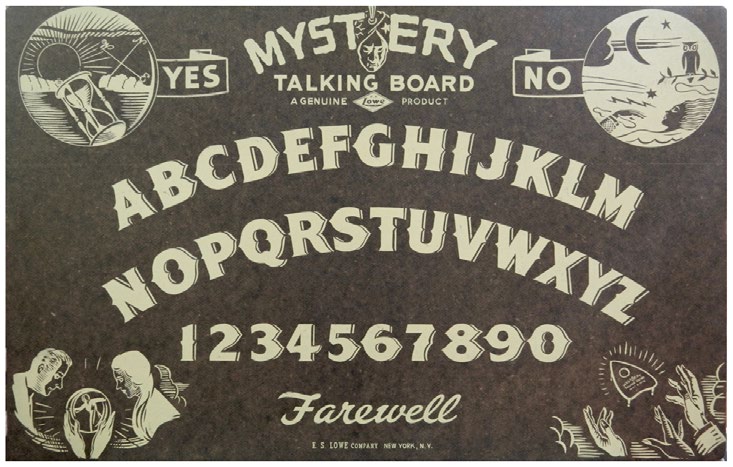
Mystery Talking Board, 1940s, E. S. Lowe Company, NY. Masonite, 18 x 22 inches.
Consider, for example, a spirit or talking board, which combines the hands of participants around a board that moves in a field of letters and numbers. Agency is distributed among the player-clients and the board itself as the planchette travels over the surface of the board. Participants place their fingers on the planchette and pose a query, then engage in an interactive process of involuntary motor reflexes that collectively move the planchette to reveal the response of the “other side” to their question.
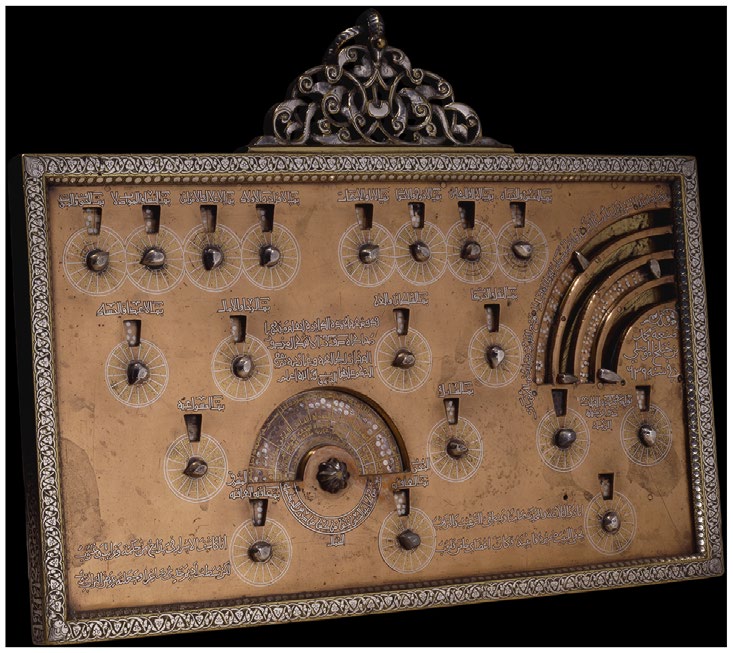
Muhammad ibn Khutlukh al-Mawi, brass geomantic instrument, 1241–42 CE, Syria, 28 × 33 inches.
In 13th-century Syria, a brass geomantic instrument combined astrological information with random manipulation of slides to generate binary codes. These codes formed dot patterns, which were interpreted using manuals and dials on the device. The final result, displayed on a rotating dial, aligned lunar information, geomantic figures, and provided answers to a client's queries.
In every case, purpose emerges from the proper manipulation of material devices, rendering randomness into information that is deciphered by means of code or lore. There is tons to study regarding the material and mechanisms by which each device is built to deliver the message with the reverence it requires – material, font choice, imagery – there is intention behind every decision made into building said devices.
Mind Map Frenzy...
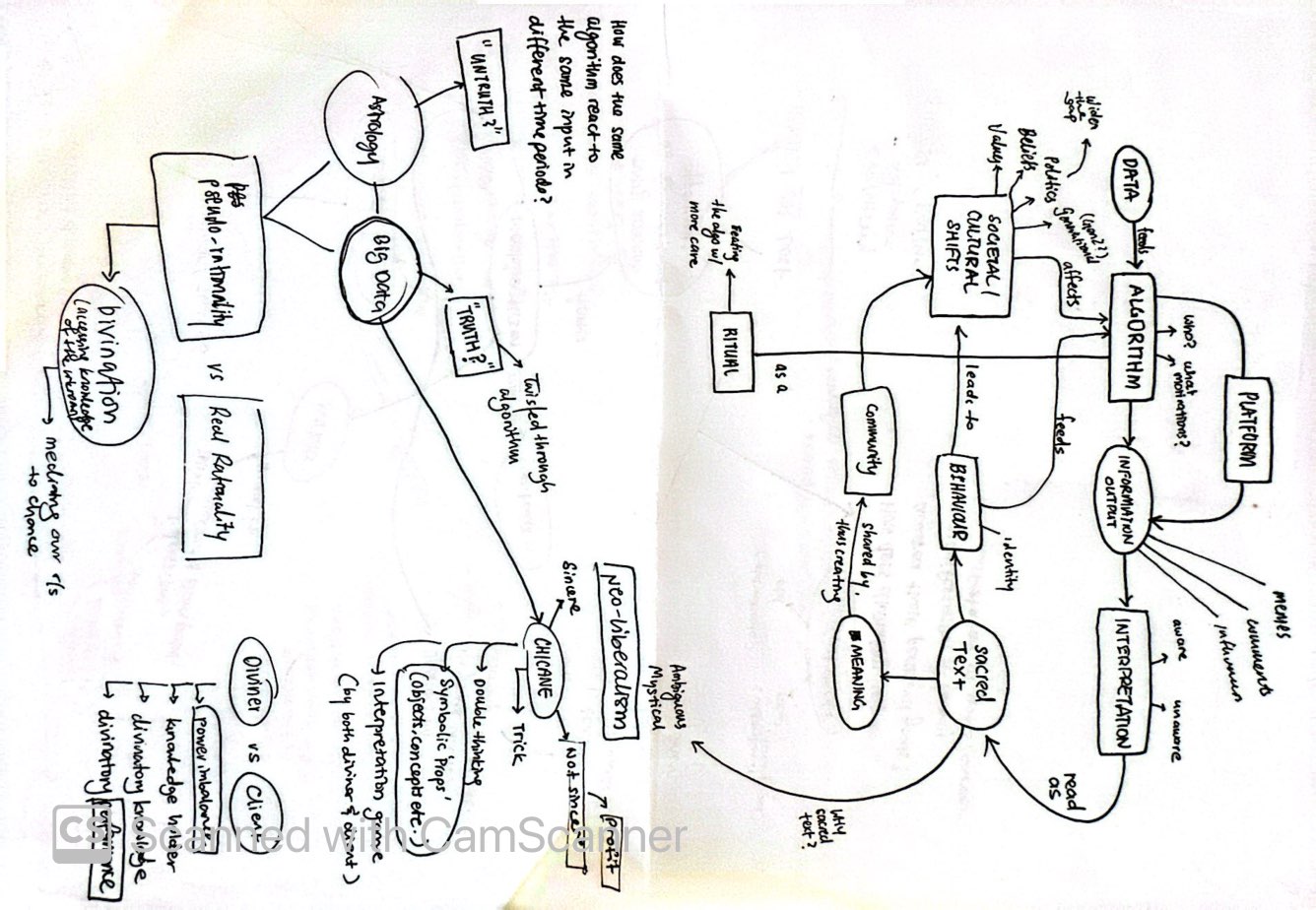
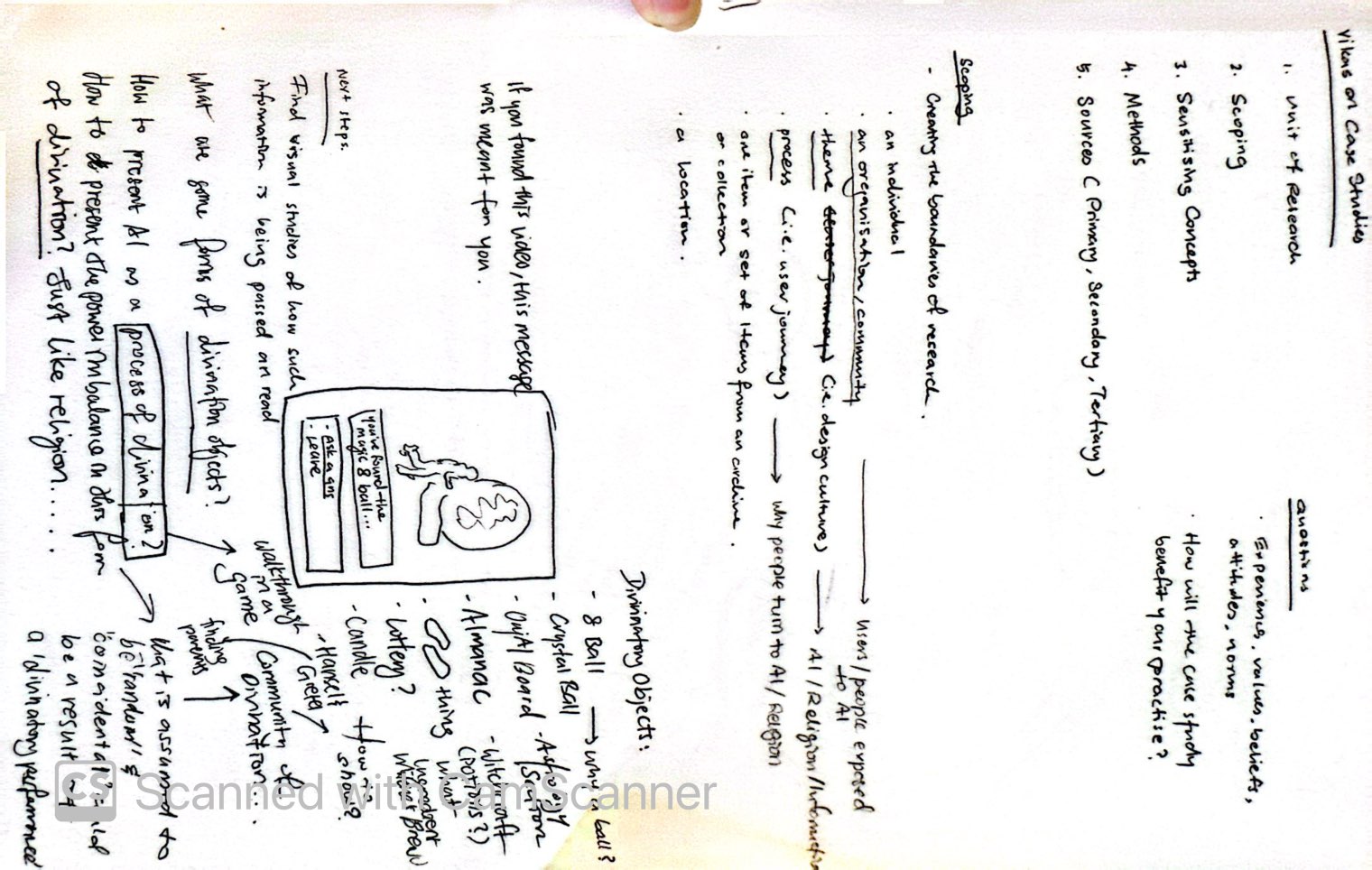
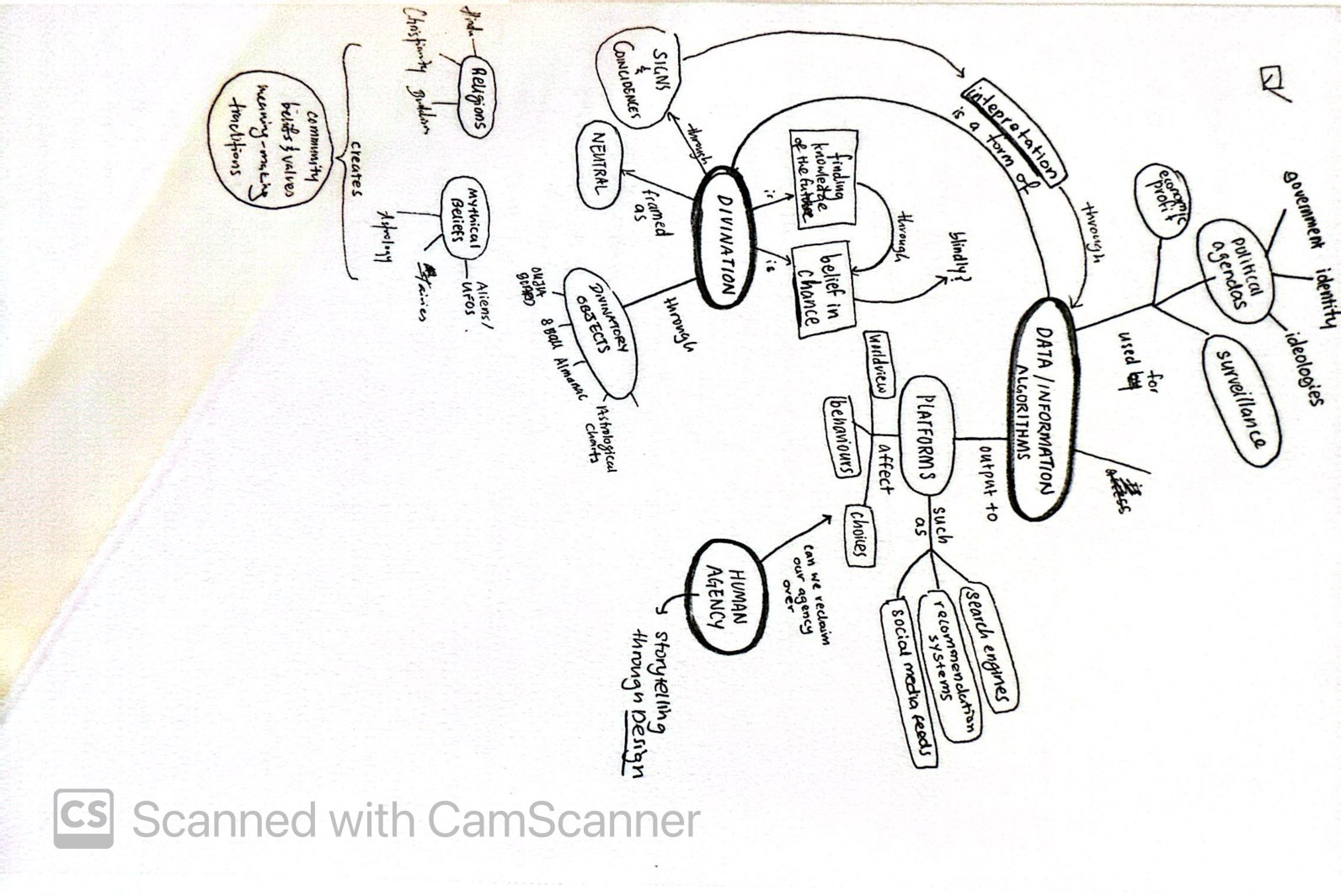
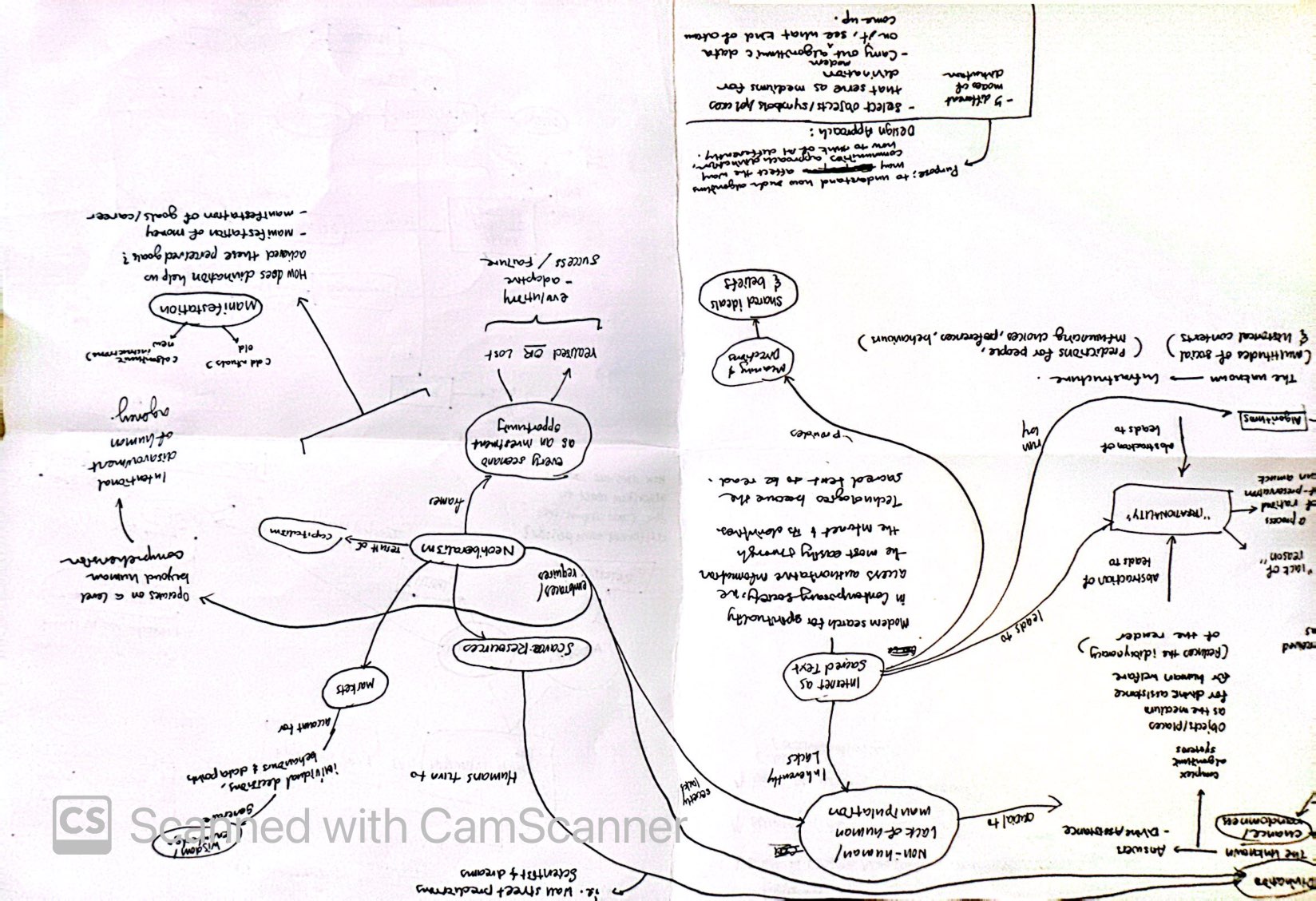
After all these readings, I proceeded to organise my thoughts through a series of mind maps that I will spare you the deatils on, mostly because I don't think I can explain my exact thought processes at this point. However, I will say that after this week, I gained a lot of clarity over the motivations behind my exploration of spiritual practices, more specifically divination, on the internet. I was able to understand better the audience, themes and processes that encompassed the scope of my project. More importantly, I have a clearer picture on how I can frame this curiosity as a design project for me to create speculation from.