Semester 2, Week 1
Reflection, Robot Saints
Reflection
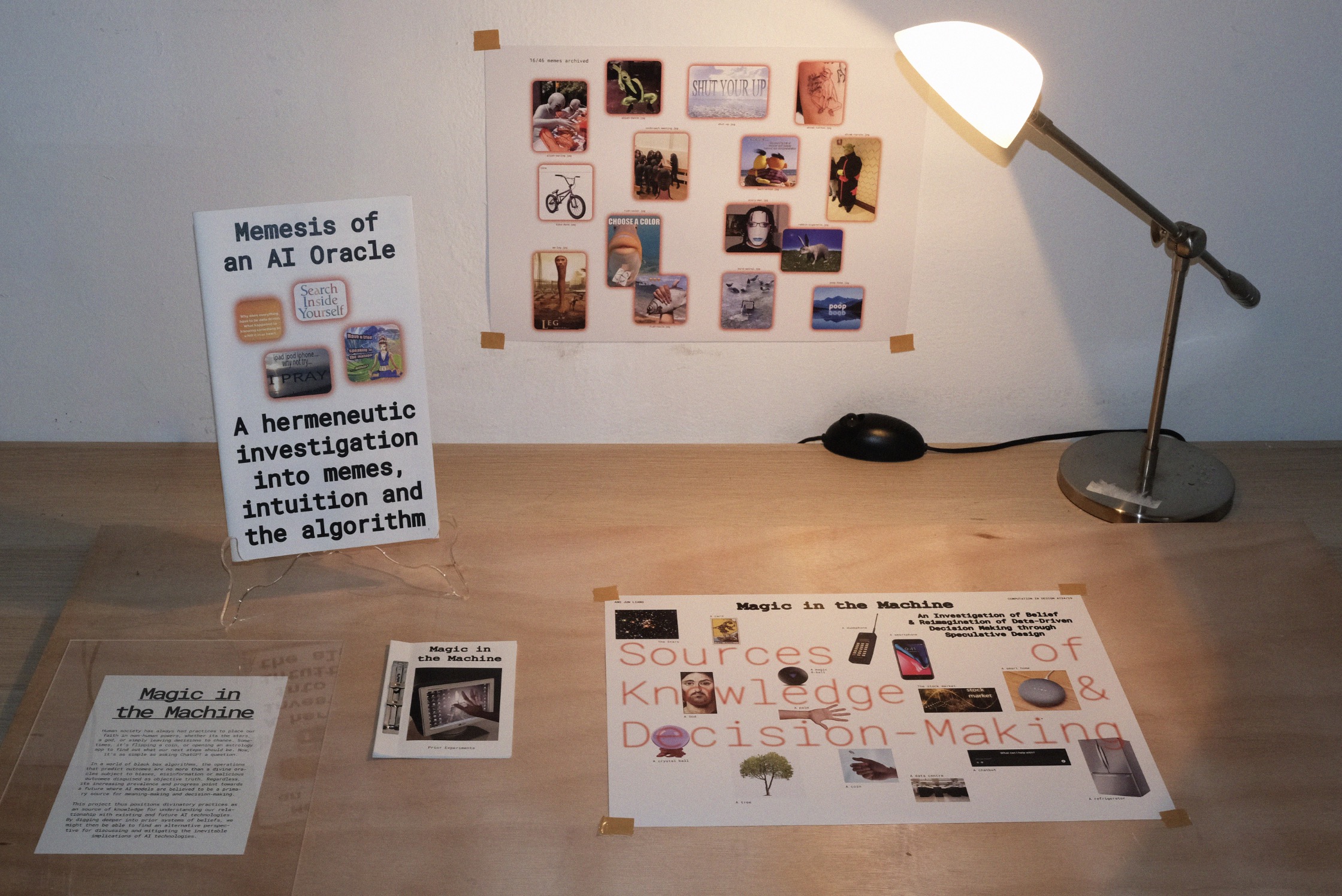
I began the new semester by reflecting on the previous semester and the feedback I received. Overall, I'm relieved that the "weirdness" of the project was well-received. I was initially worried that it would be regarded as nonsensical. I think putting my research into a book and explaining my thought process behind the absurdity helped convey my message. I came up with some actionables for myself based on the feedback and my own reflection over the break.
1. Formats of presentation
While the thought processes were important to my outcomes, I was advised by both markers to think of how to cut down on the heaviness of the content, or at least to find better ways to present them. I thought about how to create better entry points for the audience. This would mean reconsidering the hierarchy of content overall. Marker 1 suggested considering how to "create an engaging and accessible entry point for your audience with little supporting text while offering deeper insights for those who want to explore and read further?"
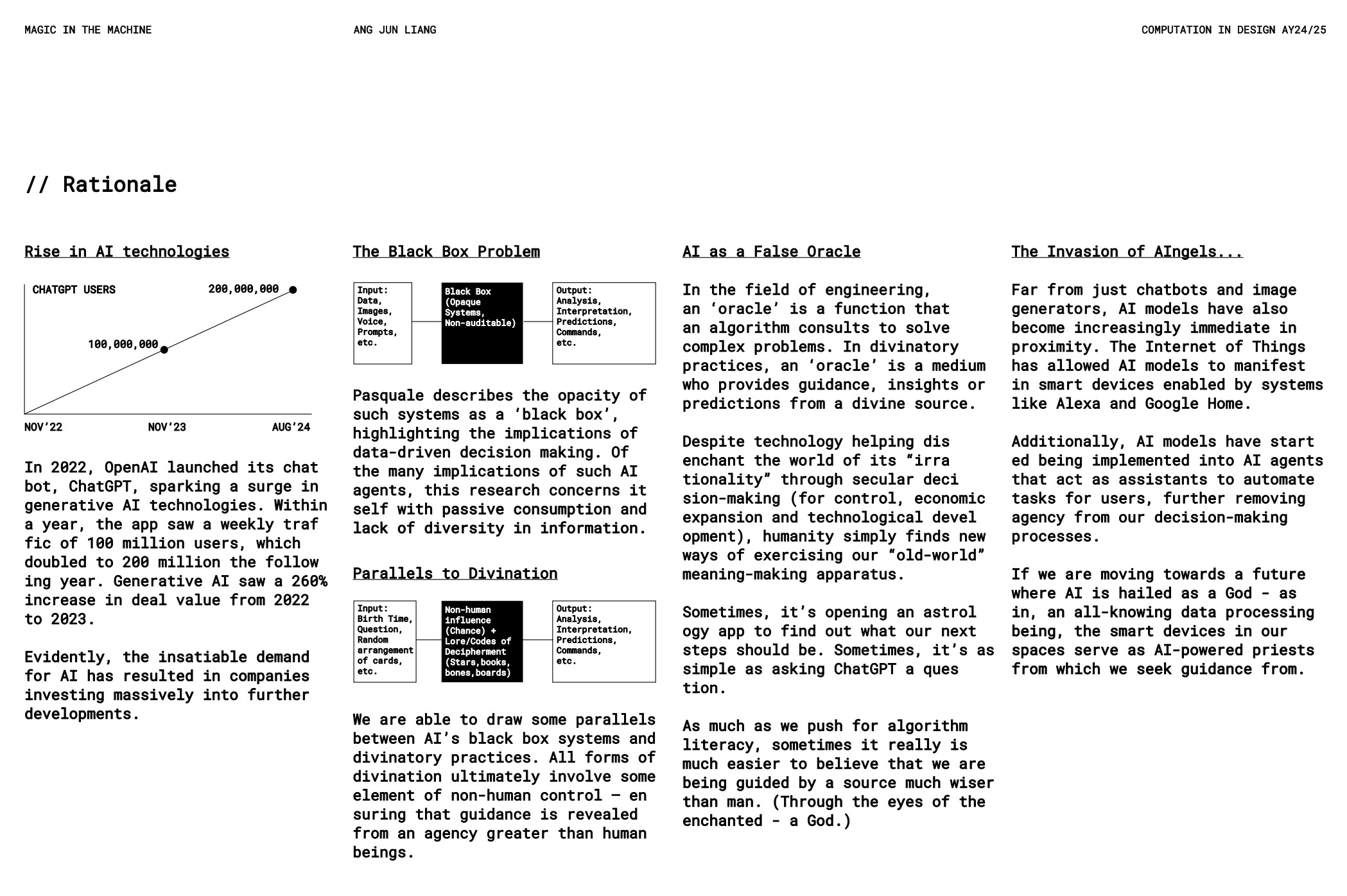
Presentation Slides - Rationale
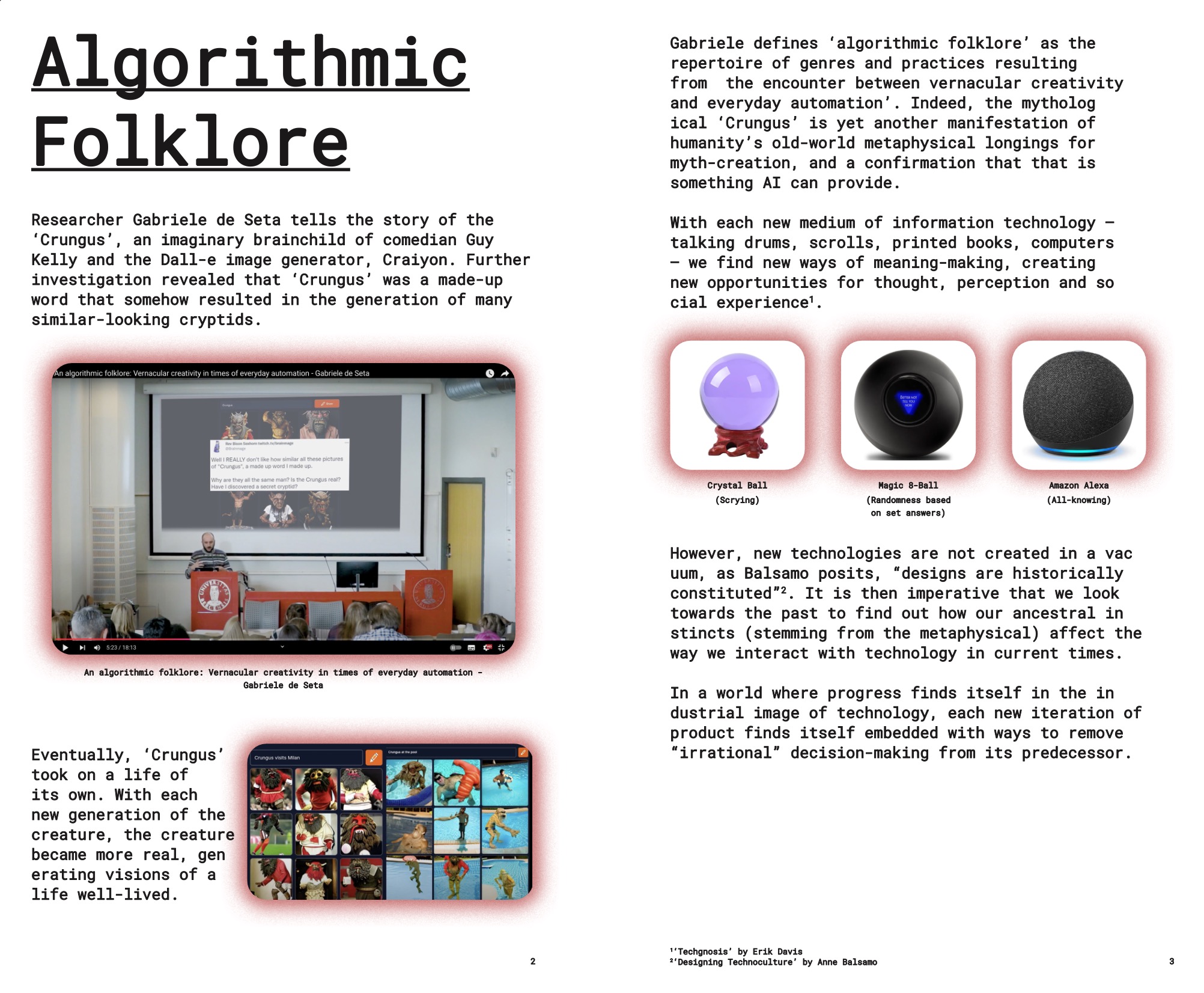
Prototype Document
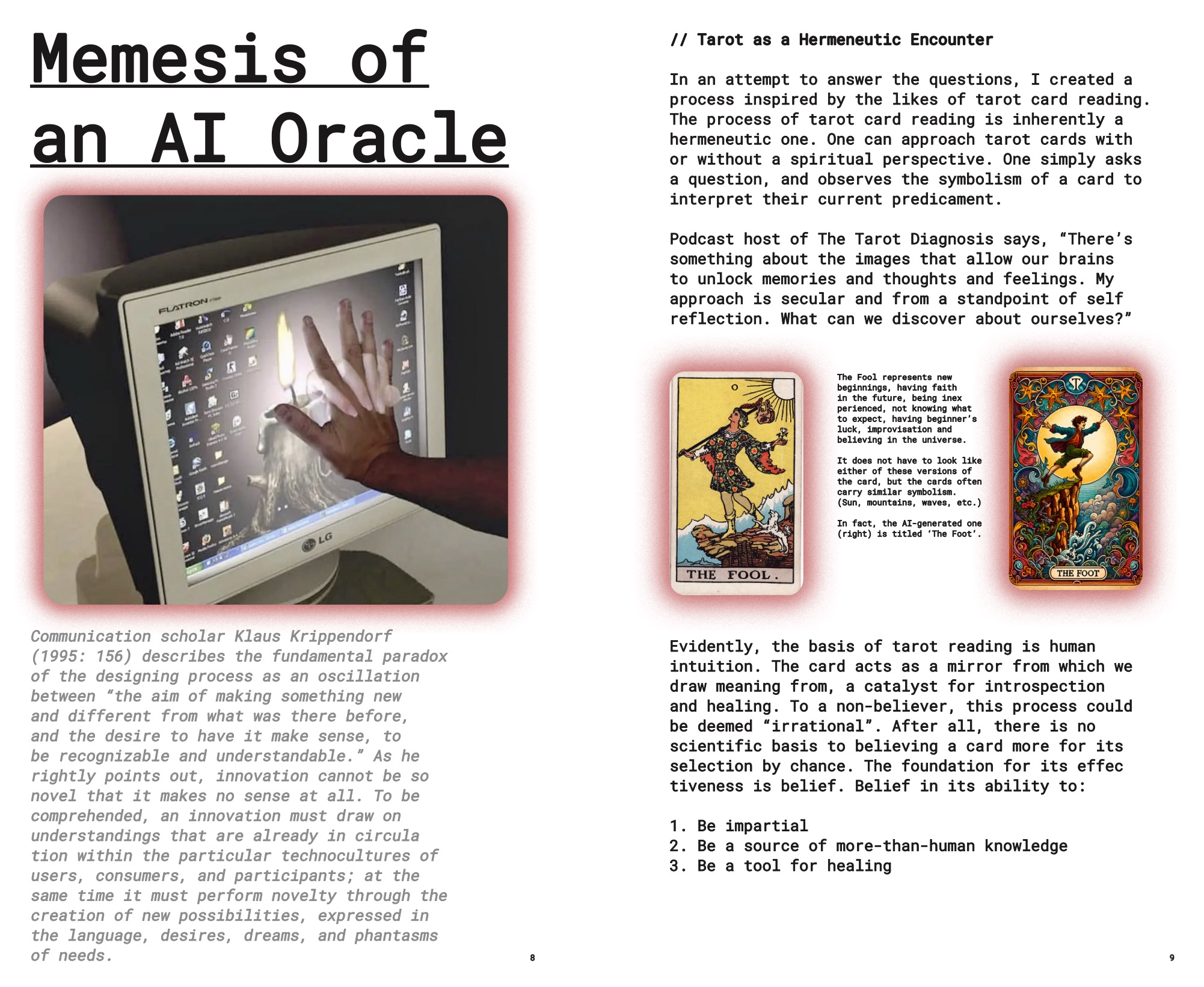
Prototype Document
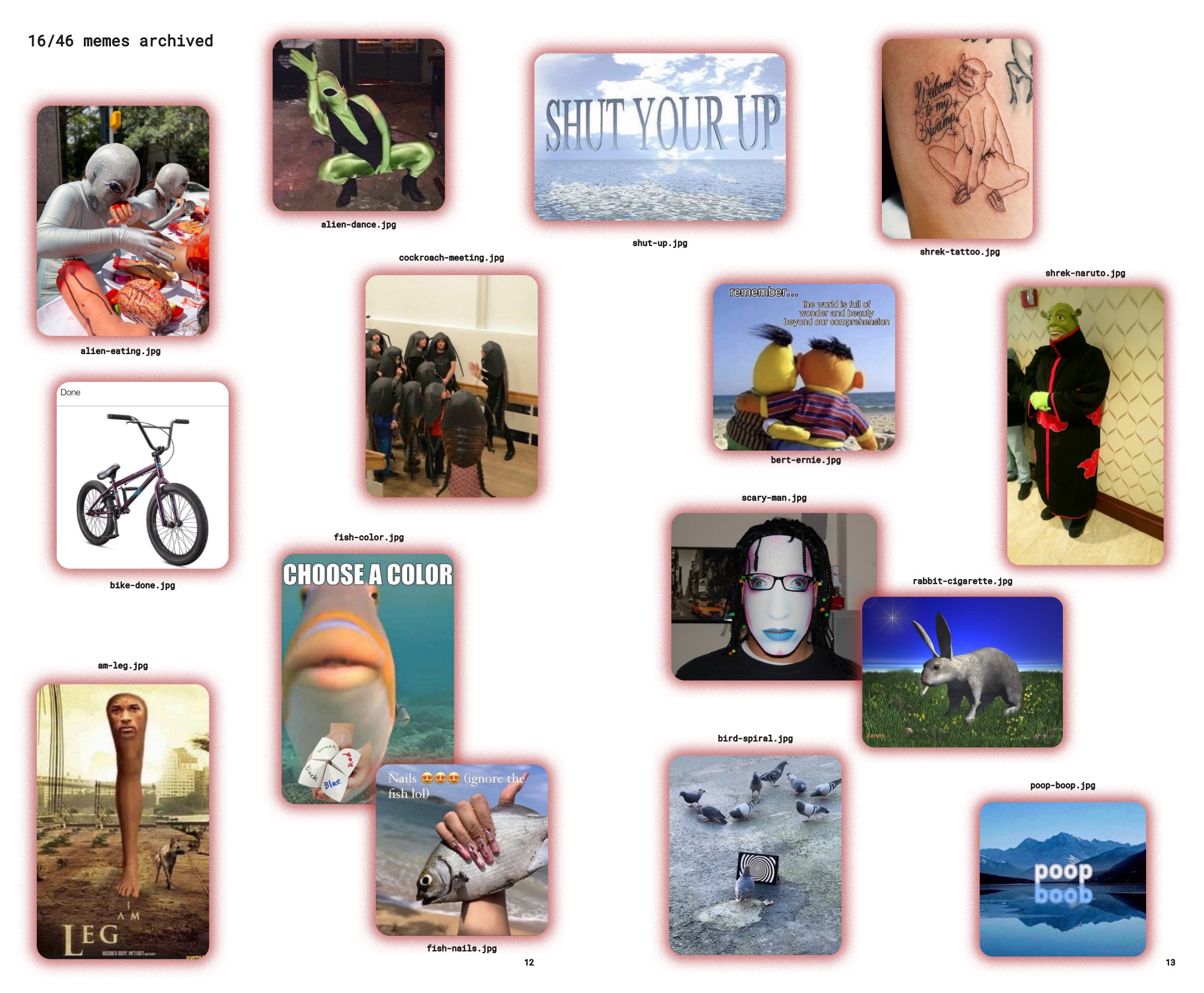
Prototype Document
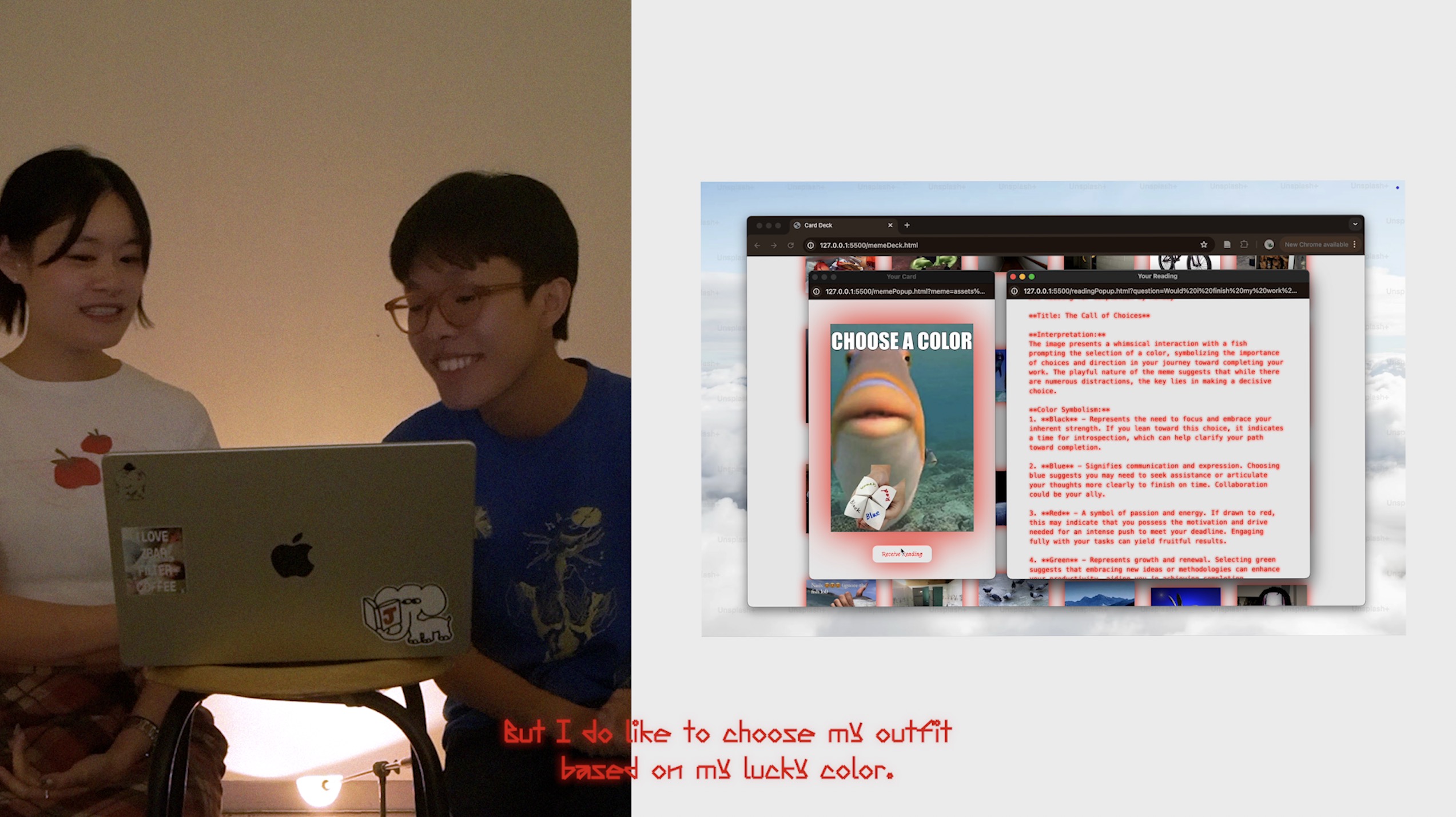
A 1-hour long video!!
2. Narrative
Another thing I intend on doing is to weave a narrative through my projects, so that the user can
follow me process. Instead of simply stating my past experiments, I would hope to present them in a way
that tells a story – that could even be imaginative or whimsical. I'm sure that also makes the whole
experience more fun for the audience.
Currently, I'm playing the role of a medium between the AI
tarot and the participant, but in a meta way. I wonder if it would be more effective for me to play up
the character of the "medium".
3. Physical Materiality
My project currently lives entirely in the digital, except for the "interview"-style reading I conducted for the meme tarot activity. I wondered if there were ways to better present my projects, with interaction, that allowed for the participant to be more engaged with the subject matter. This could be through video, interaction, etc. Another consideration for this would be for open studio/viva voce presentation. Ideally I would like the physical presentation to be more dynamic and interesting, rather than just screens and print outs. I haven't decided what that means exactly yet, but I'm keeping this in mind. I am reminded of my table setups in my exchange school. I've learnt that it is definitely way more interesting to have setups that present your work in contrasting ways, and that is something I would try to do for my project as well.
Robot Saints
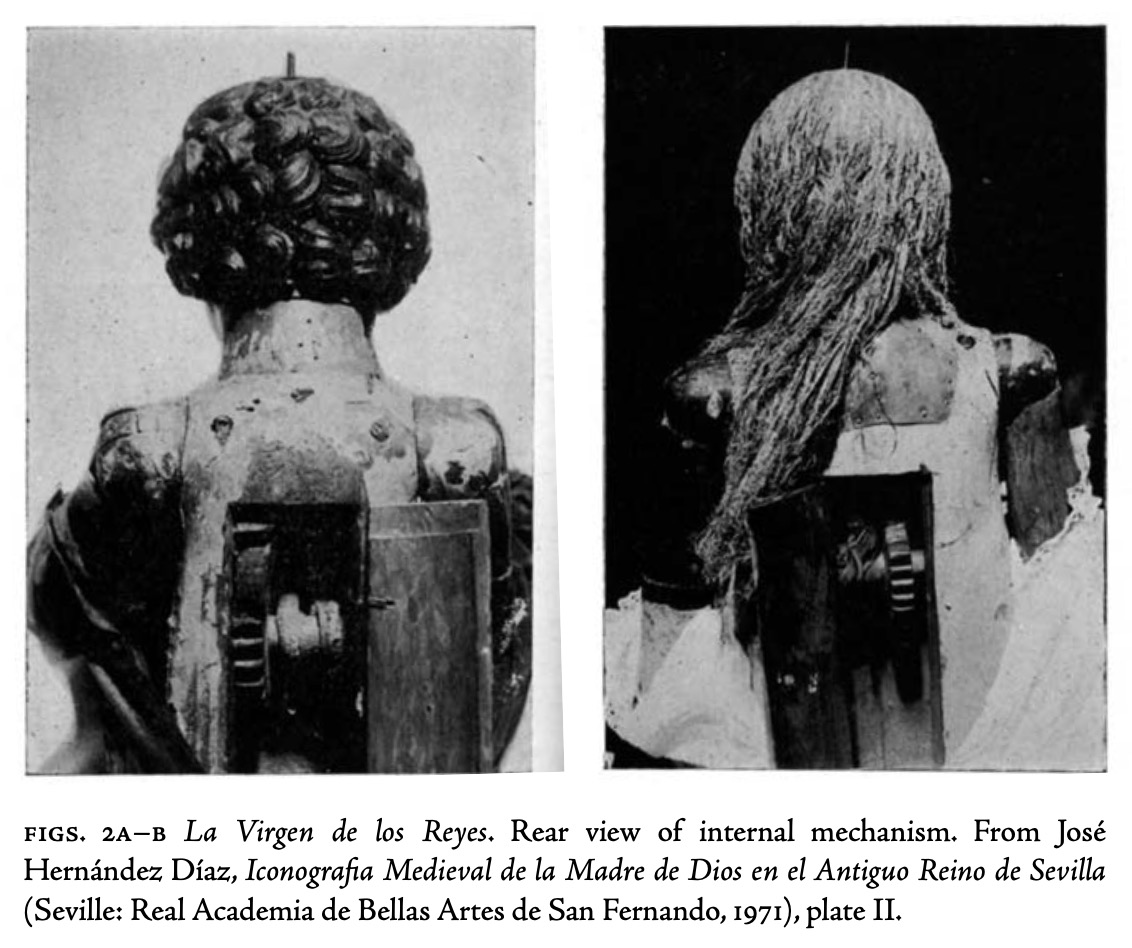
Primitive Representations of the Divine
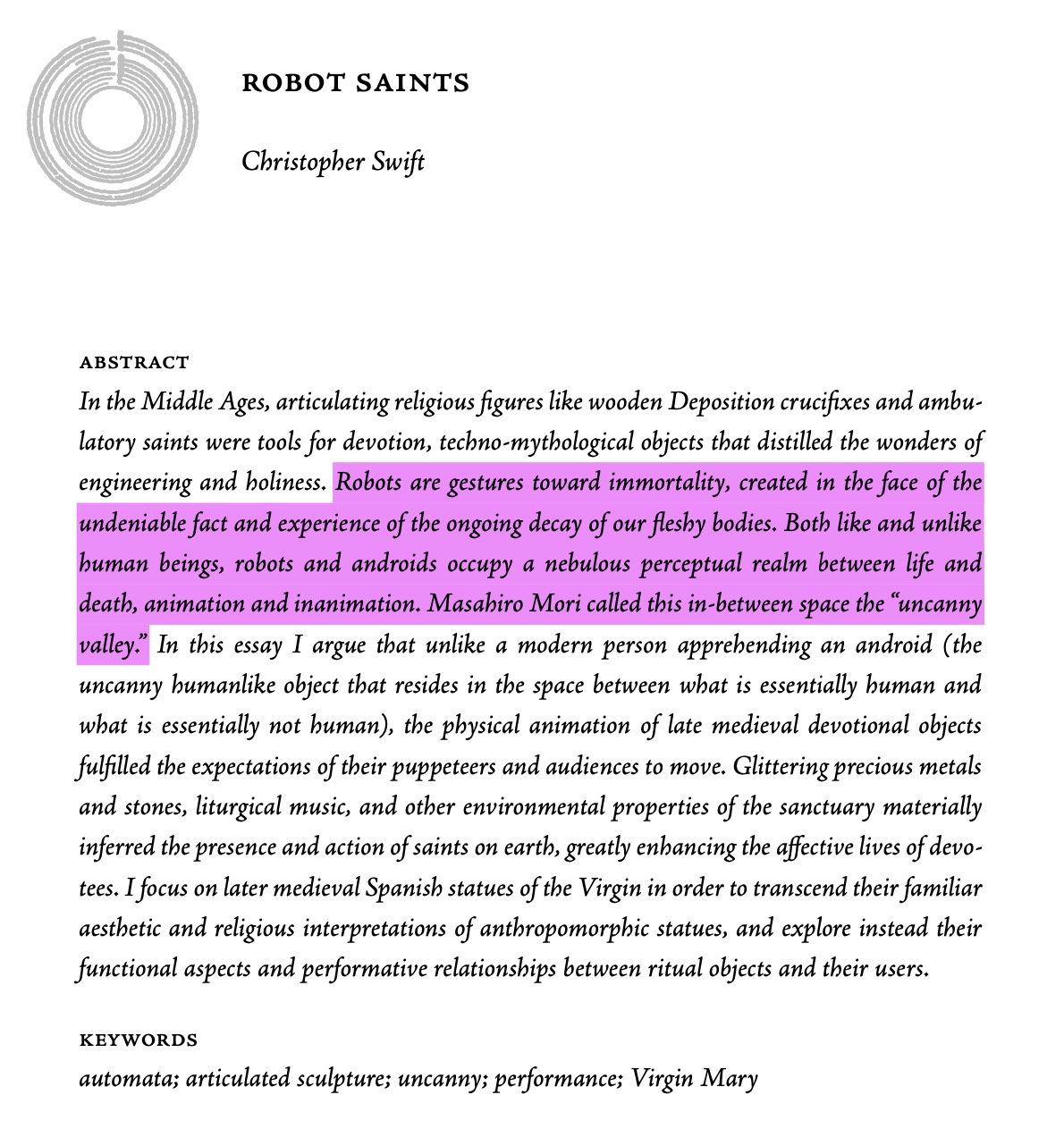
I rediscovered a reading I found earlier in the first semester called "Robot Saints." In it, the
writer researches the first manifestations of robots in religious settings, often used as a
personification of saints. Through different modes of entertainment (procession, puppetry, chant,
instrumentation, song, and epic
poetry), automation was used by craftsmen to convince audiences they are witnessing miraculous
transformations.
"Faith functions by way of transfer:
the transfer of a certain set of expectations (such as “God is listening”) into
a category that does not intuitively apply to that category (“a carved piece of
wood is listening”)."
As the studies occured at the time of medieval Europe, peoples' understanding of automative technology
were more primitive. The robots' ability to mimick biological realism thus made them especially
effective as representations of the divine – devotional tools. Notably, the practice of doublethink is
used, as the audience might be aware of the robot's mechanical nature, but still believes in its
divinity. This is perhaps attributed in part to the unfamiliarity with robots, but also largely a
suspension of belief for one's healing.
Primitive Representations of AI
Arguably, AI is in its primitive stage as well. Many are not too familiar with its inner workings
and that is the reason for both its malice and magic. There is perhaps value in the personification
of AI as a way to "enhance" the way we perceive it as a figure of trust and guidance. As spoken of
before, the language and visual cues are very much designed with intention, whether its to sound
more human or not.
"In the avant-garde theater
movements of the early twentieth century, the robot was understood in a similar way: a useful object
that held the interest of spectators because of its capacity to blur boundaries between manufactured
and biological things."
How are similar boundaries blurred in the way we interact with AI today? How are our current
understandings, or lack thereof, of AI shaping the way we receive its information?
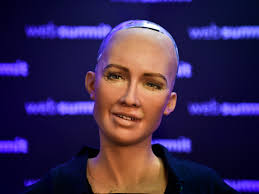
Obviously, Sophia isn't a real human. However, how much suspension of belief do we allow to interact with it as if she was?