Semester 2, Week 2
Mind Mapping, Jiao Bei Simulator 2
Dissertation – Discussion
Recap of experiments to recontextualise my learnings for the readers and myself, based on my existing research from the literature review.
1. Digital Simulation of the Jiaobei
As a semiotic study, I wanted to recap what I learnt about the elements of signification in digital divination. I started with a mind map to identify the elements that made up the complete interpretation of the jiao bei divination.
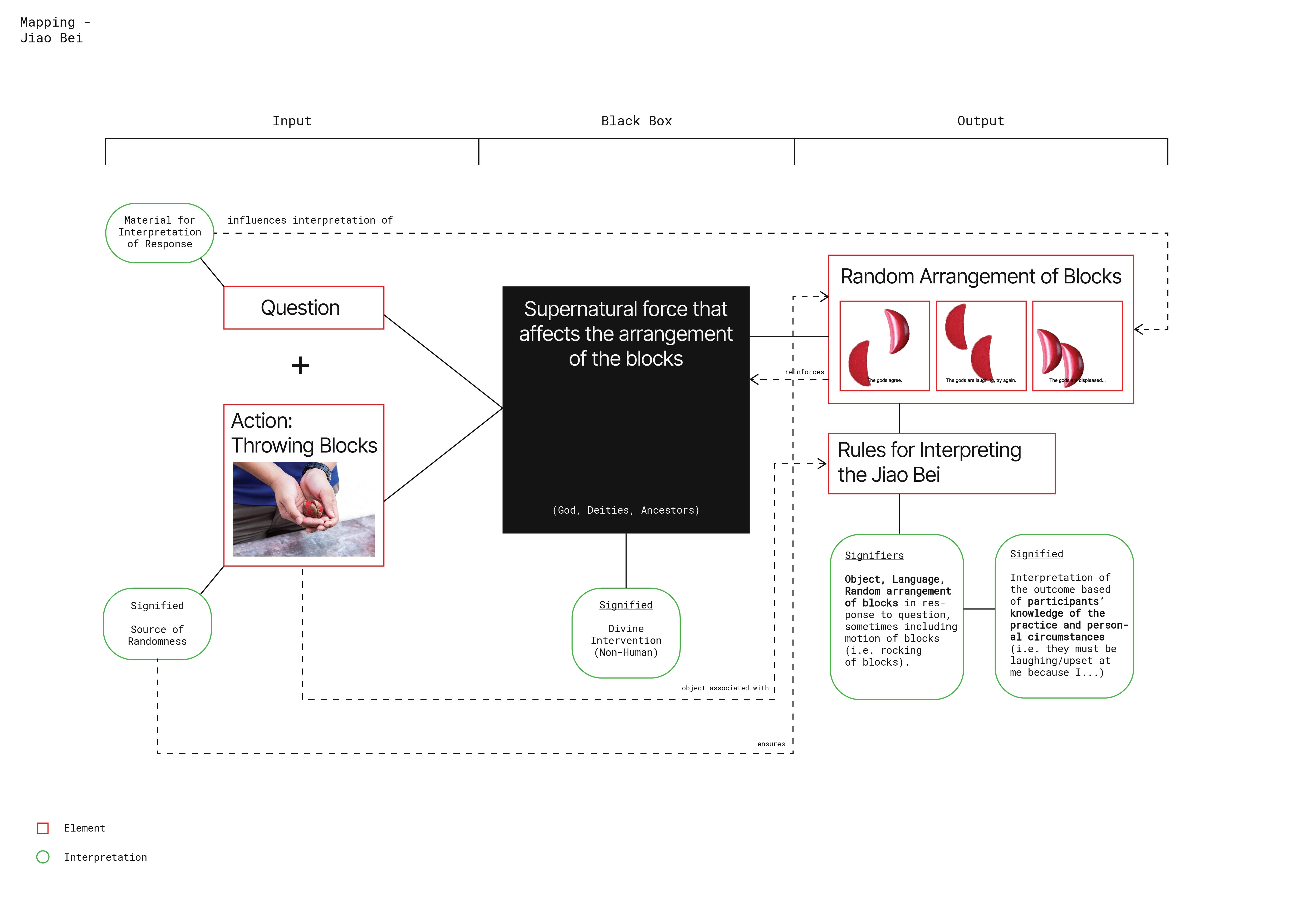
Jiaobei - Map of Significance
Then, I mapped out the parts that were affected by the digital simulation — image, language, and probability.
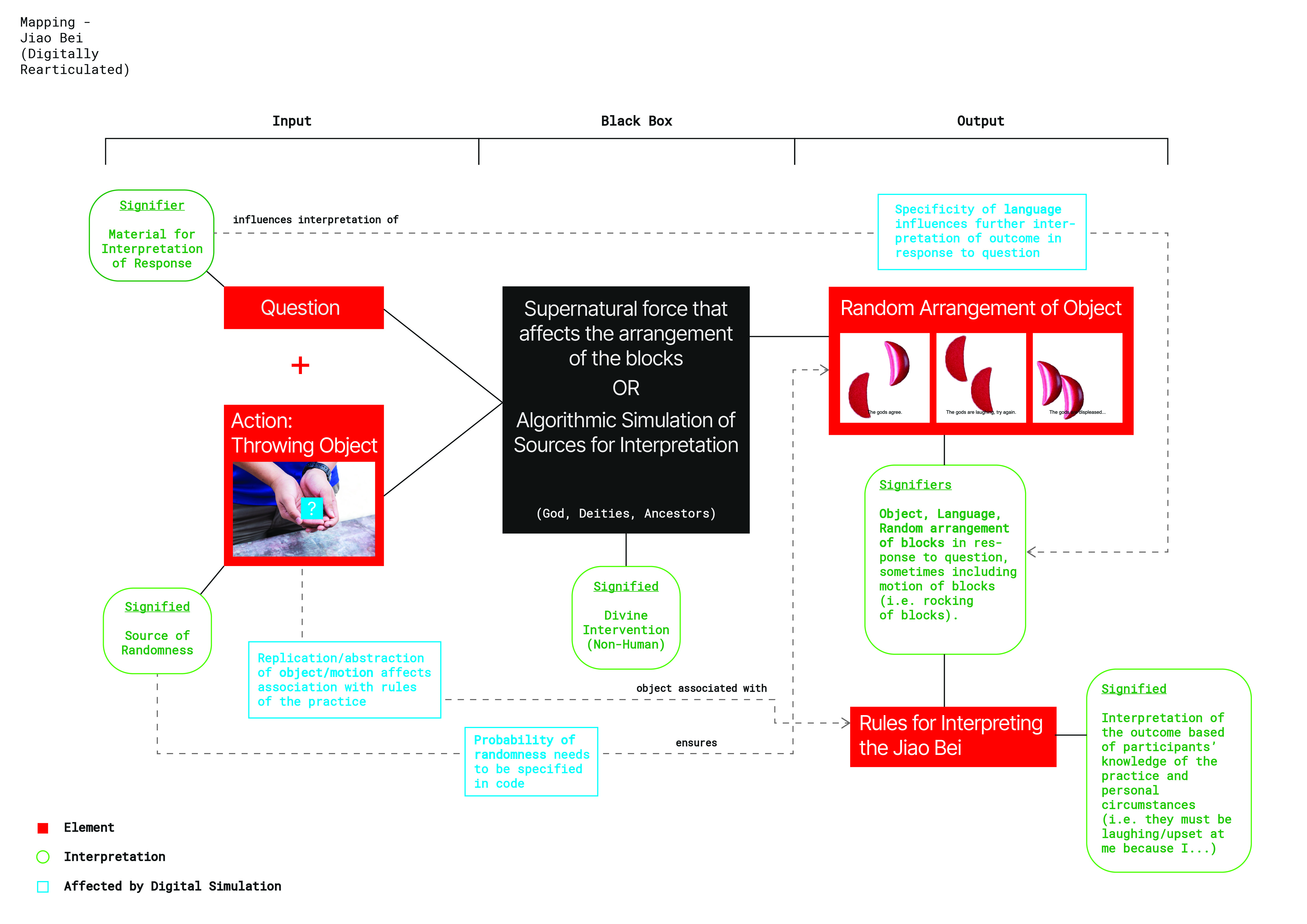
Jiaobei (Digital) - Map of Significance
Simulating Divinatory Intelligence, Doublethink, Objective Judgements
This experiment has provided a study of what Jean-Pierre Vernant describes as “divinatory
intelligence”, which highlights the specific intellectual processes that occur within the
participants. Often, divinatory practices aim to reach a resolution through such hermeneutic
processes, for “truth-as-unconcealment”. A true simulation of the jiǎo bēi would
require the designer to account for all source elements for interpretation embodied in the
divinatory
objects present. This requires both the designer and the participant to engage in
double-thinking:
the designer must rationalise the irrational, while the participants — whether consciously or
not —
suspend their awareness of human manipulation to achieve resolution and meaning-making.
The functions that make these possible are examples of a subjective objective function, in which
an
objective judgement is made in an otherwise subjective situation. The success of the simulation
is
thus not only dependent on the ability of the designer to replicate the interpretative elements,
but
also limited by the participants willingness to accommodate the subjectivity of the objective
functions inevitably present in the simulation.
Introduction of Sliders
To illustrate these learnings, I incorporated sliders to make the image and probability interactive for the user. While I recognise it is not the most effective solution, it does allow the participant to question how the changes affect their interpretation of the activity. Perhaps a better description or narrative would help to better convey the message.